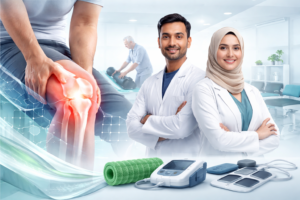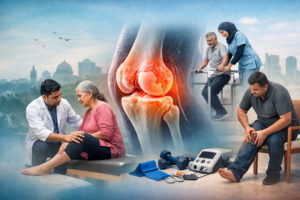
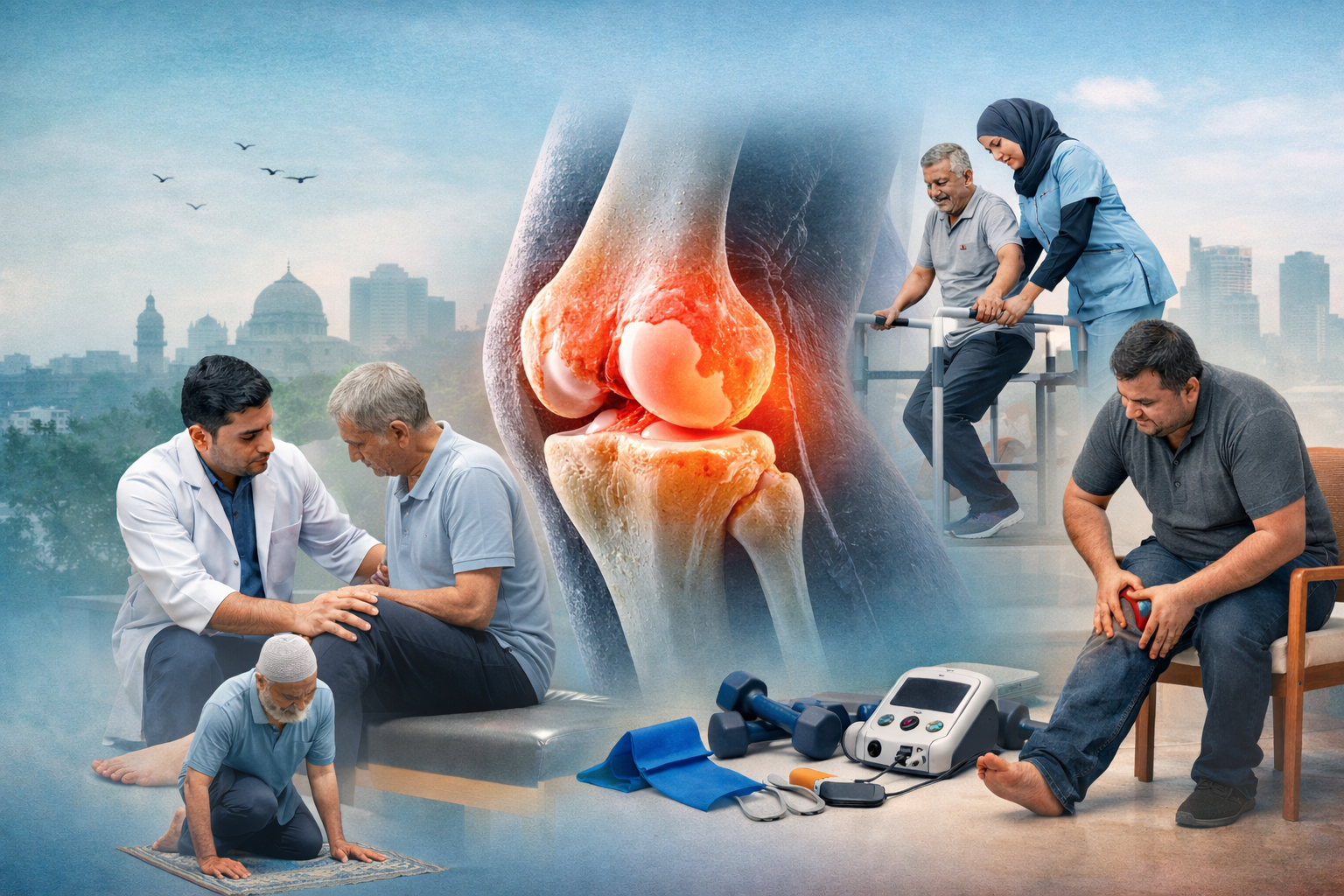
Knee pain is one of the most widespread musculoskeletal problems affecting people across Bangladesh. It affects individuals of all ages, from young adults involved in sports or physically demanding occupations to elderly individuals suffering from age-related joint degeneration. Persistent knee pain can significantly limit mobility and independence, making everyday activities such as walking, climbing stairs, standing for long periods, praying, or sitting on the floor difficult and painful. As a result, many people experience reduced productivity, restricted physical activity, and a lower overall quality of life.
In Bangladesh, knee pain is often associated with long-term pain medication or the possibility of surgery. While medications may provide temporary relief, they rarely address the underlying causes of knee problems. Over the past decade, however, medical science and rehabilitation practices have advanced considerably. Today, non-surgical treatment approaches particularly evidence-based physiotherapy and structured rehabilitation have proven to be highly effective for managing most knee pain conditions. By focusing on correcting joint mechanics, strengthening muscles, and restoring proper movement patterns, physiotherapy can help patients recover safely and avoid invasive surgical procedures.
Among the leading providers of non-surgical knee pain treatment in Bangladesh, ASPC Manipulation Therapy Centre has established a strong reputation for delivering professional, patient-centered care. The center specializes in treating musculoskeletal pain using modern physiotherapy techniques, manual therapy, and individualized rehabilitation programs. Instead of focusing only on symptom relief, ASPC emphasizes identifying the root causes of knee pain and designing targeted treatment strategies that promote long-term recovery and prevention.
The center operates under the expert guidance of Dr. Mohammad Shahadat Hossain, PT, a well-known pain management specialist, and Dr. Sapia Akter, PT, an experienced physiotherapy specialist. Their combined expertise in musculoskeletal rehabilitation, manual therapy, and physiotherapy enables them to accurately diagnose complex knee conditions and develop personalized treatment plans for each patient. Through careful clinical assessment, evidence-based physiotherapy, and continuous patient support, they help individuals regain mobility, reduce pain, and return to their daily activities with confidence.
Because of its commitment to ethical practice, accurate diagnosis, and effective non-surgical treatment, ASPC Manipulation Therapy Centre has become a trusted destination for patients seeking safe and long-lasting solutions for knee pain in Bangladesh. By prioritizing functional recovery and patient education, the center continues to help thousands of individuals avoid unnecessary surgery and achieve a healthier, more active life.
Understanding Knee Pain and Why It Should Not Be Ignored
The knee joint is one of the largest and most complex joints in the human body. It connects the thigh bone (femur) with the shin bone (tibia) and relies on ligaments, cartilage, muscles, and tendons for stability and smooth movement. Because the knee bears body weight and supports repetitive movement throughout the day, it is highly vulnerable to injury, degeneration, and mechanical stress.
Knee pain may appear suddenly after an injury or develop gradually over time due to poor posture, muscle weakness, incorrect movement patterns, or degenerative changes. When knee pain is ignored or treated only with painkillers, the underlying problem often worsens, leading to chronic pain, joint stiffness, reduced mobility, and loss of independence. Early, non-surgical intervention plays a critical role in preventing long-term damage and restoring normal knee function.
Common Causes of Knee Pain in Bangladesh
The lifestyle, occupational demands, and daily habits of people in Bangladesh contribute significantly to knee problems. These include:
Why Non-Surgical Knee Pain Treatment Is the Preferred Choice
Non-surgical treatment has become the preferred approach because surgery is not always necessary or the most effective first option. In some situations, surgical procedures may be recommended before addressing contributing factors such as muscle weakness or joint instability. When these issues are not corrected, pain may persist even after surgery. Non-surgical treatment focuses on identifying and correcting the root causes rather than simply masking the symptoms.
Role of Physiotherapy in Non-Surgical Treatment
Physiotherapy is the cornerstone of non-surgical knee pain management. It combines scientific assessment, manual therapy, therapeutic exercise, and patient education to restore normal knee function.
- Reducing pain and inflammation through manual techniques.
- Improving joint mobility and strengthening supporting muscles.
- Correcting posture and movement patterns.
- Enhancing balance and preventing future injury.
ASPC Manipulation Therapy Centre: A Leader in Care
ASPC Manipulation Therapy Centre is widely recognized in Bangladesh for its excellence in non-surgical musculoskeletal treatment. The center follows international standards, focusing on accurate diagnosis and individualized care.
Dr. Mohammad Shahadat Hossain, PT
A renowned pain management specialist known for identifying hidden causes of knee pain missed in conventional treatments. His approach prioritizes sustainable recovery over short-term pain suppression.
- Advanced clinical assessment
- Complex and chronic pain expertise
- Evidence-based treatment planning
Dr. Sapia Akter, PT
An experienced specialist who restores strength, mobility, and confidence through structured exercise programs tailored to each patient’s age and goals.
- Customized strengthening programs
- Special care for elderly & female patients
- Long-term joint health planning
Comprehensive Knee Pain Assessment at ASPC
Every patient undergoes a detailed evaluation including pain history, alignment analysis, gait assessment, muscle testing, and joint mobility evaluation. This forms the foundation for our advanced treatments:
Patient Outcomes and Satisfaction
Many patients at ASPC notice measurable improvements within just a few sessions. Common reports include significant reduction in stiffness, better mobility (stairs, walking), and a regained confidence in movement. Importantly, patients report reduced dependence on medication and, in many cases, successfully avoid surgery altogether by strengthening the natural support structures of the knee.
The ASPC Comparison
In Bangladesh, while institutions like CRP, BRB, and PPRC offer essential rehabilitation services, their high patient volumes often result in standardized protocols. ASPC Manipulation Therapy Centre distinguishes itself through highly personalized assessment. We identify structural and biomechanical causes specific to you, ensuring that Dr. Shahadat and Dr. Sapia are directly involved in your recovery process from day one.
Conclusion: Achieving a Pain-Free Life
Knee pain is a widespread problem in Bangladesh that can greatly affect your independence. Relying on temporary solutions or delaying professional care only worsens the condition. ASPC Manipulation Therapy Centre provides a trusted, non-surgical pathway to recovery.
Under the leadership of Dr. Mohammad Shahadat Hossain, PT and Dr. Sapia Akter, PT, our center combines clinical diagnosis with advanced physiotherapy to help you avoid unnecessary surgery and regain your quality of life. Take the first step toward sustainable, long-term joint health today.