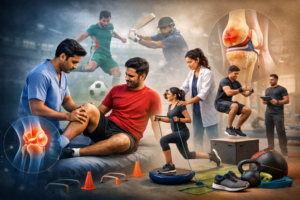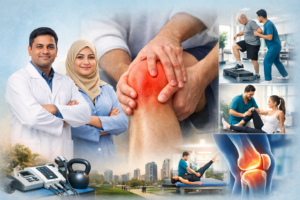
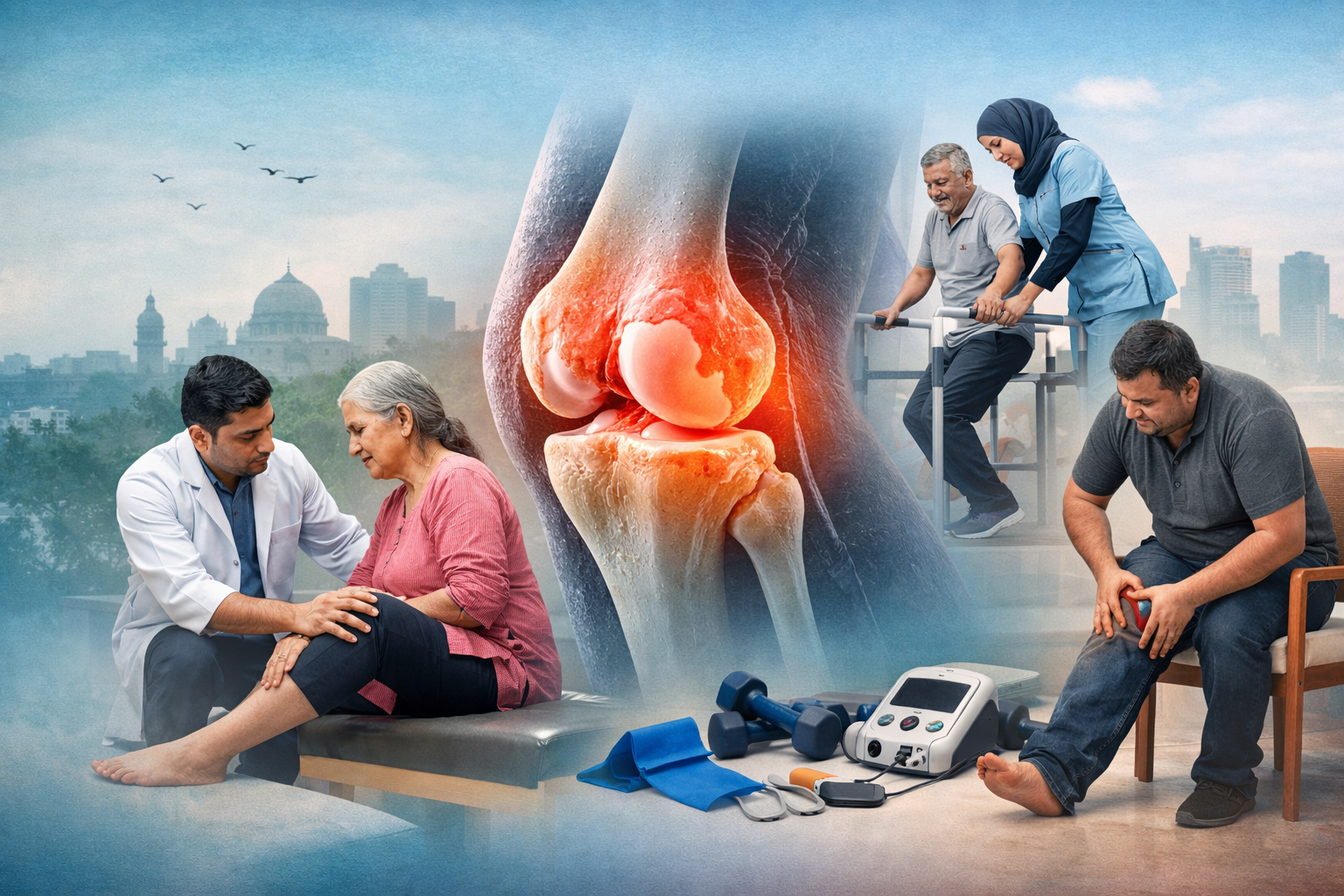
Knee arthritis has become a major public health concern in Dhaka and across Bangladesh. With increasing life expectancy, rapid urbanization, reduced physical activity, rising obesity rates, and demanding occupational lifestyles, the number of people suffering from knee arthritis is steadily increasing. This condition not only causes persistent knee pain but also significantly limits mobility, independence, and overall quality of life. Many patients struggle with everyday activities such as walking, climbing stairs, standing for prayer, getting in and out of chairs, or performing routine household and work-related tasks.
In Bangladesh, knee arthritis is often misunderstood as a condition that will inevitably lead to knee replacement surgery. As a result, many individuals depend on painkillers for years or live with the fear that surgery is their only option. However, modern medical research clearly demonstrates that physiotherapy is one of the most effective non-surgical treatments for knee arthritis. Through accurate assessment, targeted exercise programs, manual therapy, and lifestyle adjustments, physiotherapy can significantly reduce pain, improve joint function, and slow the progression of the disease.
Among the physiotherapy centers in Dhaka, ASPC Manipulation Therapy Centre has developed a strong reputation for its specialized approach to knee arthritis treatment. The center focuses on non-surgical management and evidence-based physiotherapy techniques designed to improve mobility and joint stability. Rather than relying solely on medication for symptom relief, ASPC emphasizes treating the underlying mechanical and muscular factors that contribute to knee arthritis pain.
The center operates under the expert clinical leadership of Dr. Mohammad Shahadat Hossain, PT, a renowned pain management specialist, and Dr. Sapia Akter, PT, an experienced physiotherapy specialist. Their combined expertise in musculoskeletal rehabilitation, physiotherapy, and manual therapy allows them to carefully evaluate each patient’s condition and design individualized treatment plans. Through structured rehabilitation programs and continuous patient guidance, they help patients reduce pain, regain confidence in movement, and maintain a more active lifestyle.
Because of its commitment to evidence-based care, ethical practice, and patient-centered rehabilitation, ASPC Manipulation Therapy Centre has become one of the most trusted destinations in Dhaka for individuals seeking effective physiotherapy treatment for knee arthritis without surgery.
Understanding Knee Arthritis in Detail
Knee arthritis, most commonly osteoarthritis, is a degenerative joint disorder characterized by the gradual deterioration of articular cartilage within the knee joint. Cartilage plays a crucial role in joint health by reducing friction and absorbing shock during movement. As cartilage wears away, joint surfaces become rough, leading to pain, inflammation, stiffness, and restricted movement.
Unlike acute injuries, knee arthritis develops slowly over time. Many patients initially experience mild discomfort or stiffness, which they often ignore. Over months or years, symptoms gradually worsen, leading to chronic pain and functional disability. Without proper intervention, knee arthritis can significantly impair independence and mental well-being.
It is important to understand that arthritis is not only a problem of cartilage loss. Muscle weakness, poor joint alignment, altered movement patterns, reduced balance, and psychological fear of movement all contribute to symptom severity. This is why physiotherapy plays a central role in comprehensive arthritis management.
Common Symptoms of Knee Arthritis
Risk Factors in the Dhaka Population
Physiotherapy: The Cornerstone of Management
Physiotherapy is not merely an optional treatment for knee arthritis—it is a core, evidence-based intervention recommended by international clinical guidelines. While medication may reduce pain temporarily, it does not address the underlying biomechanical and muscular issues that drive disease progression.
Key Objectives of Treatment
- Pain reduction without long-term medication dependence
- Improvement of joint mobility and flexibility
- Strengthening muscles that support and protect the knee
- Enhancing balance and coordination
- Restoring confidence in movement and delaying surgery
ASPC Manipulation Therapy Centre
ASPC Manipulation Therapy Centre is widely recognized for its expertise in non-surgical musculoskeletal care. The center follows a patient-centered approach that emphasizes accurate diagnosis and individualized treatment planning.
Dr. Mohammad Shahadat Hossain, PT
Known for advanced clinical reasoning, his expertise identifies subtle movement dysfunctions. He focuses on optimizing joint loading through biomechanical assessment and safe manual therapy to ensure long-term functional capacity.
Dr. Sapia Akter, PT
Specializes in translating clinical assessments into effective rehabilitation. She emphasizes gradual progression, therapeutic exercises, and rebuilding patient confidence, especially for elderly and female patients.
Comprehensive Assessment & Interventions
Every patient begins with a structured evaluation covering pain history, functional limitations, knee alignment, muscle strength, gait analysis, and balance testing. Based on this, we deploy advanced interventions:
Lifestyle Modification & Patient Education
Effective management extends beyond clinic sessions. ASPC emphasizes weight management, as even small reductions in weight significantly decrease joint pressure. We educate patients on safe physical activity, activity pacing (balancing rest/movement), and the importance of supportive footwear. Adherence to a personalized home exercise program is vital for long-term joint stability.
Conditions Managed at ASPC
- Knee Osteoarthritis (Early to Advanced stages)
- Post-traumatic Knee Arthritis (after ligament/fracture injury)
- Age-related degenerative changes
- Chronic knee pain with functional limitations
- Post-surgical knee stiffness (ligament repair/replacement)
Comparison: The ASPC Difference in Dhaka
While institutions like CRP, BRB, and PPRC contribute significantly to rehabilitation in Bangladesh, their high patient volumes often necessitate standardized protocols. ASPC differentiates itself through personalized evaluation and specialist-led care. By focusing on the root causes rather than generic routines, we provide a more focused and patient-centered experience under the direct supervision of Dr. Shahadat Hossain and Dr. Sapia Akter.
Conclusion: Regain Your Mobility
Knee arthritis is a progressive condition that can significantly affect independence if not managed. Relying solely on medication or fearing surgery doesn’t have to be your path. Modern evidence-based physiotherapy at ASPC Manipulation Therapy Centre offers a sustainable, non-surgical alternative.
Under the expert leadership of Dr. Mohammad Shahadat Hossain, PT and Dr. Sapia Akter, PT, our center provides the specialized care needed to reduce pain and avoid unnecessary surgery. We are committed to helping the people of Dhaka live healthier, more active lives through professional musculoskeletal rehabilitation.
Take the first step toward pain-free movement today.